glossary
ADHD words, explained honestly
A lot of ADHD language comes from the community, not from research. That doesn’t make it less useful. Each word here is marked so you know what it is.
research termexpert modelcommunity term
ADHD burnout
community termNot a medical diagnosis. A name for deep exhaustion from constantly managing and masking ADHD symptoms. Signs can include exhaustion, sleep problems and lost motivation.
Source: ADHD burnout, Understood · Read more →
ADHD paralysis (task paralysis)
community termNot a medical diagnosis, but a common term for feeling overwhelmed, frozen and unable to start. Cleveland Clinic describes mental, task and choice paralysis.
Source: ADHD paralysis, Cleveland Clinic · Read more →
ADHD tax
community termAn informal term for money lost to ADHD-related slips: late fees, replacing lost items, impulse buys. Early survey research points the same way.
Source: How do you pay the “ADHD tax”?, ADDitude · Read more →
Body doubling
community termWorking on a task while another person is present, in person or online. There isn’t much research yet, but some people with ADHD find it really helps.
Source: Body doubling for ADHD: what it is and how it works, Understood · Read more →
Brain dump
community termWriting down everything on your mind, in any order, until your head feels quieter. Sort afterwards, or not at all.
Bedtime procrastination (“revenge bedtime procrastination”)
research termGoing to bed later than you meant to, with nothing outside stopping you. Researchers defined it in 2014; the “revenge” part is a social-media label.
Source: Kroese et al., “Bedtime procrastination: introducing a new area of procrastination”, Frontiers in Psychology, 2014 · Read more →
Doom pile
community termA pile of mixed, unsorted things moved out of the way “for later”. DOOM: Didn’t Organize, Only Moved.
Source: Doom piles and ADHD, ADDitude · Read more →
Emotional dysregulation
research termDifficulty managing the intensity of emotions. CHADD calls it common in ADHD and says it was part of earlier official descriptions of ADHD before being removed.
Source: Emotions feel like too much? It could be a symptom of ADHD, CHADD
Executive function
research termA set of mental skills, including working memory, flexible thinking and self-control, used to plan, organize and get things done. People with ADHD often struggle with them.
Source: What is executive function?, Understood · Read more →
Hyperfocus
community termIntense, absorbed focus where everything else fades. A very common ADHD experience, but not an official symptom, and not well researched yet.
Source: Understanding ADHD and hyperfocus, Understood · Read more →
Interest-based nervous system
expert modelDr. William Dodson’s description of ADHD attention as driven by interest, challenge, novelty, urgency and passion rather than importance. From clinical practice, not proven research.
Source: William Dodson, MD, “Secrets of your ADHD brain”, ADDitude · Read more →
“Object permanence”
community termUsed informally for “out of sight, out of mind”: forgetting things you know exist. It isn’t a recognized ADHD symptom; the original term comes from child development.
Source: Object permanence and ADHD, Medical News Today · Read more →
Pomodoro technique
expert modelA time-management method by Francesco Cirillo: work in timed blocks with short breaks. Classic blocks are 25 minutes, but shorter blocks are fine.
Source: The Pomodoro Technique, Francesco Cirillo · Read more →
Rejection sensitive dysphoria (RSD)
community termNot an official diagnosis. Describes intense emotional pain in response to perceived rejection or criticism. It’s unknown how many people with ADHD experience it.
Time blindness
community termNot having a clear sense of time passing. The term is informal, but research links ADHD to differences on timing tasks.
Waiting mode
community termStruggling to start anything when a commitment is coming up later, even with plenty of time before it.
Source: Time blindness and “waiting mode”, ADDitude · Read more →
Wall of Awful
expert modelA model by ADHD coach Brendan Mahan: built-up shame, guilt, fear and disappointment from past attempts that make starting a task feel impossible.
Source: Brendan Mahan, Overcoming the Wall of Awful, Hachette · Read more →
Working memory
research termThe mental “sticky note” that holds information while you use it. Part of executive function. A brain dump takes some load off it.
Source: What is executive function?, Understood · Read more →
Practical, non-clinical explanations. Nothing here is a diagnosis or medical advice.
free printable kit
Free: the Fresh Start Kit
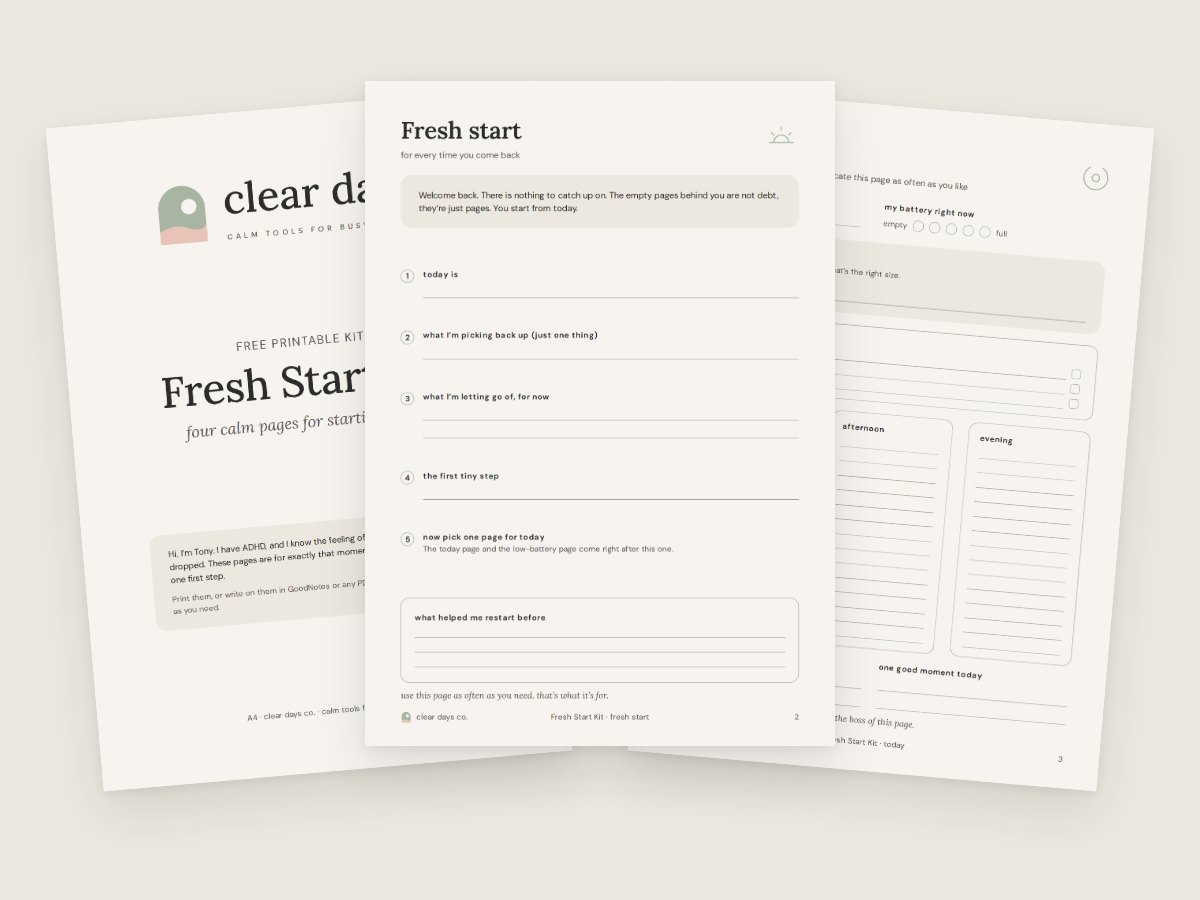
Six calm pages for the moment you come back to a plan you dropped: a fresh start page, a one-first-step today page, a low-battery day page and a write-it-all-down page. A4 and US Letter.
Get the free kitNo catching up. Just one first step.