time · 2-minute read
Time blindness: what it is, and what helps
in 30 seconds
- “Time blindness” describes not having a clear sense of time passing. Understood credits psychologist Russell Barkley with the idea.
- A 2021 review of 55 studies found that people with ADHD, on average, did less well on timing tasks.
- What helps most is outside help: clocks in sight, visual timers, buffers and early alarms.
Time blindness is the experience of not having a clear sense of time: ten minutes feel like two, and a “five-minute” task eats the afternoon. It isn’t a diagnosis, but it’s a common ADHD experience, and research does link ADHD to differences in how people judge and reproduce time.
Why it happens
Understood describes time blindness as not having a clear sense of time, and credits psychologist Russell Barkley with the term. Research backs up the experience: a 2021 meta-analysis by Marx and colleagues pooled 55 studies and found timing differences in ADHD across every type of timing task they looked at. The authors note it isn’t yet a clinical tool, but the pattern is consistent.
In everyday terms: if your inner sense of time is less reliable, outside clocks have to do more of the work.
Five ways to make time visible
Put time where you can see it
Understood suggests clocks in every room and a visible calendar. Seeing the time beats remembering to check it.
Tiny version: Move one clock into your line of sight.
Low-energy version: Turn on the clock on your phone’s lock screen.
Use a timer that shows time shrinking
A shape that gets smaller is easier to read at a glance than numbers.
Tiny version: Set two minutes. Understood suggests starting with two if fifteen feels too long.
Low-energy version: Hide the numbers and just watch the disc.
Guess first, then check
Before a task, guess how long it takes. Time it. Write both down. After a few tries, your guesses get kinder and more accurate.
Tiny version: Guess one task today.
Low-energy version: Skip it. Guessing is for good-energy days.
Add a buffer to anything with a start time
Plan backwards from when you need to arrive, then add ten minutes for the unexpected.
Tiny version: Leave five minutes earlier than feels necessary.
Low-energy version: Set one alarm for “leave now”.
Set transition alarms
An alarm ten minutes before you need to stop gives your brain time to wrap up.
Tiny version: One alarm before your next appointment.
Low-energy version: Ask someone to text you a reminder.
Make time visible right now
A calm timer with a shrinking disc, a soft chime and no ads.
Open the visual timerwhen you’re running late
Running about 10 minutes late, sorry! See you at 3:10.
What timers can’t do
Timers and clocks help many people, but they don’t change how your brain senses time. If alarms start to blend into the background, change the sound, the place or the person reminding you.
Questions people ask
Is time blindness real?
The term is informal, but research shows people with ADHD, on average, do differently on timing tasks. The experience is real for many people.
Is it only an ADHD thing?
Anyone can lose track of time. The research summarized here compared groups with and without ADHD.
What’s the best timer?
The one you’ll actually see. Visual timers work well for many people because they show time instead of counting it.
When to get support: This guide shares everyday strategies, not medical advice. If this is making daily life hard for weeks, talk to a doctor or a mental health professional. If you’re in crisis, you can find free, confidential support in your country at findahelpline.com.
Sources
free printable kit
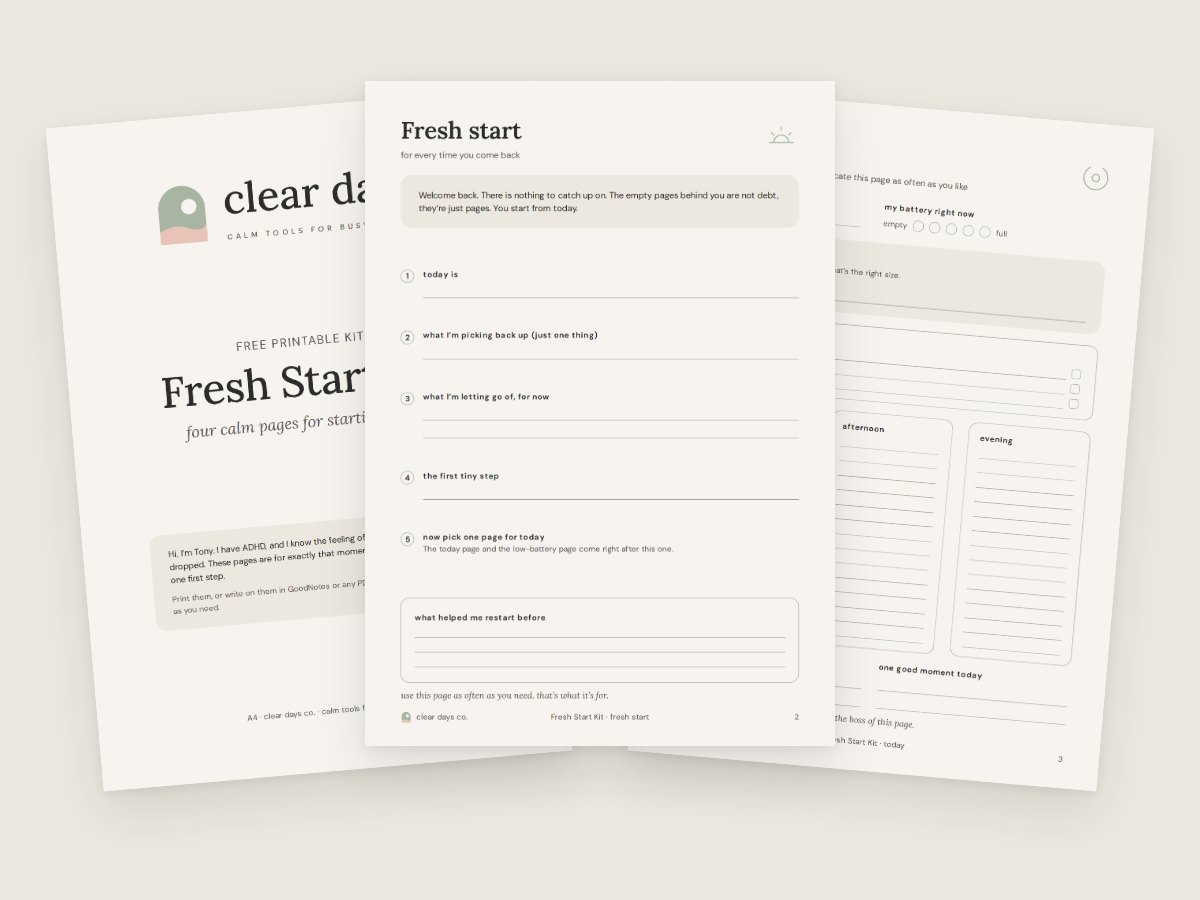
Free: the Fresh Start Kit
Six calm pages for the moment you come back to a plan you dropped: a fresh start page, a one-first-step today page, a low-battery day page and a write-it-all-down page. A4 and US Letter.
Get the free kitNo catching up. Just one first step.